
Real systems we designed, built, and run: an operations platform, a private assistant grounded in a company's own material, a large researched content library, and a 20-year track record of software that lasts. We build our own house first, so the flagship three all run in our own companies today.
 The AI systems shown here were designed and built by Christopher Grant, GORGES Chief AI Officer.
Three things AI can build for a business, and one of each running right now: work that runs itself, answers from your own material, and research or content at a scale no one could write by hand. Underneath sits a 20-year track record of software that lasts.
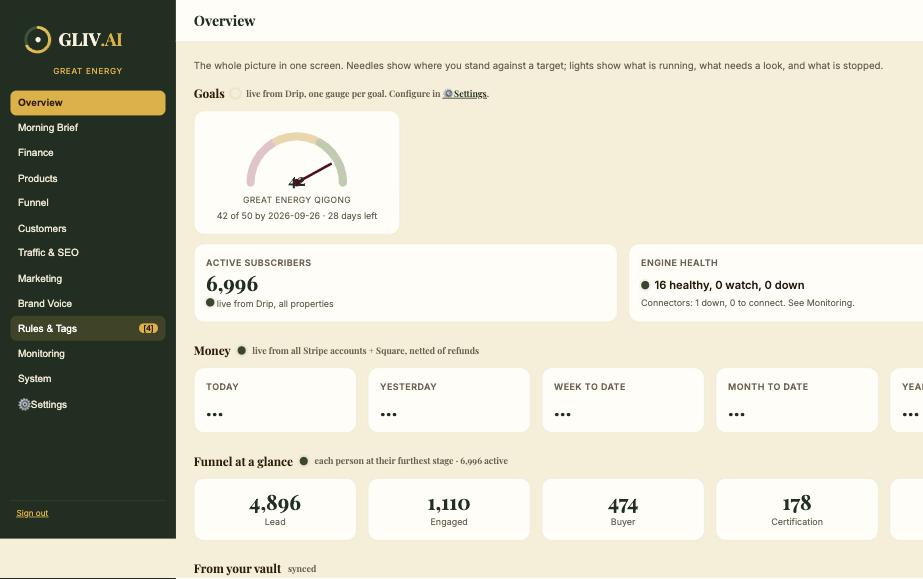
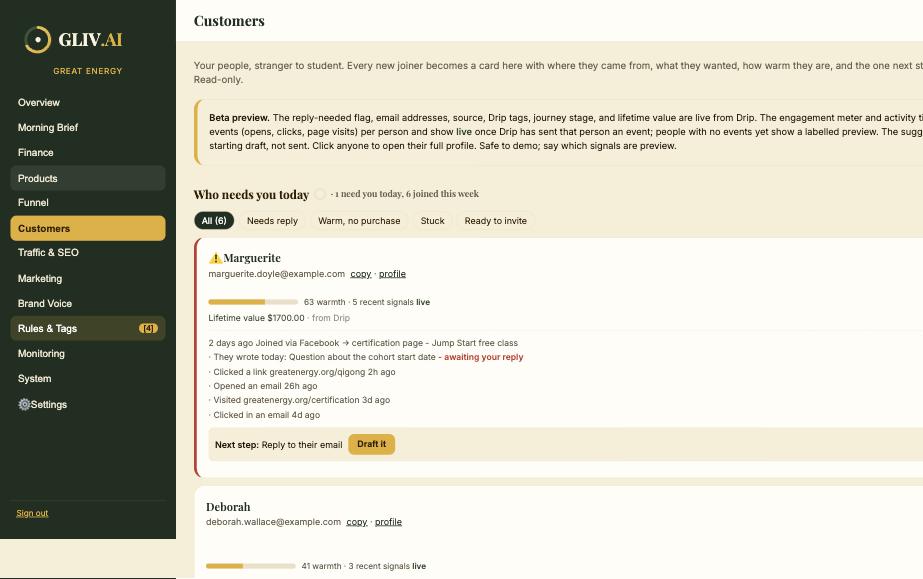
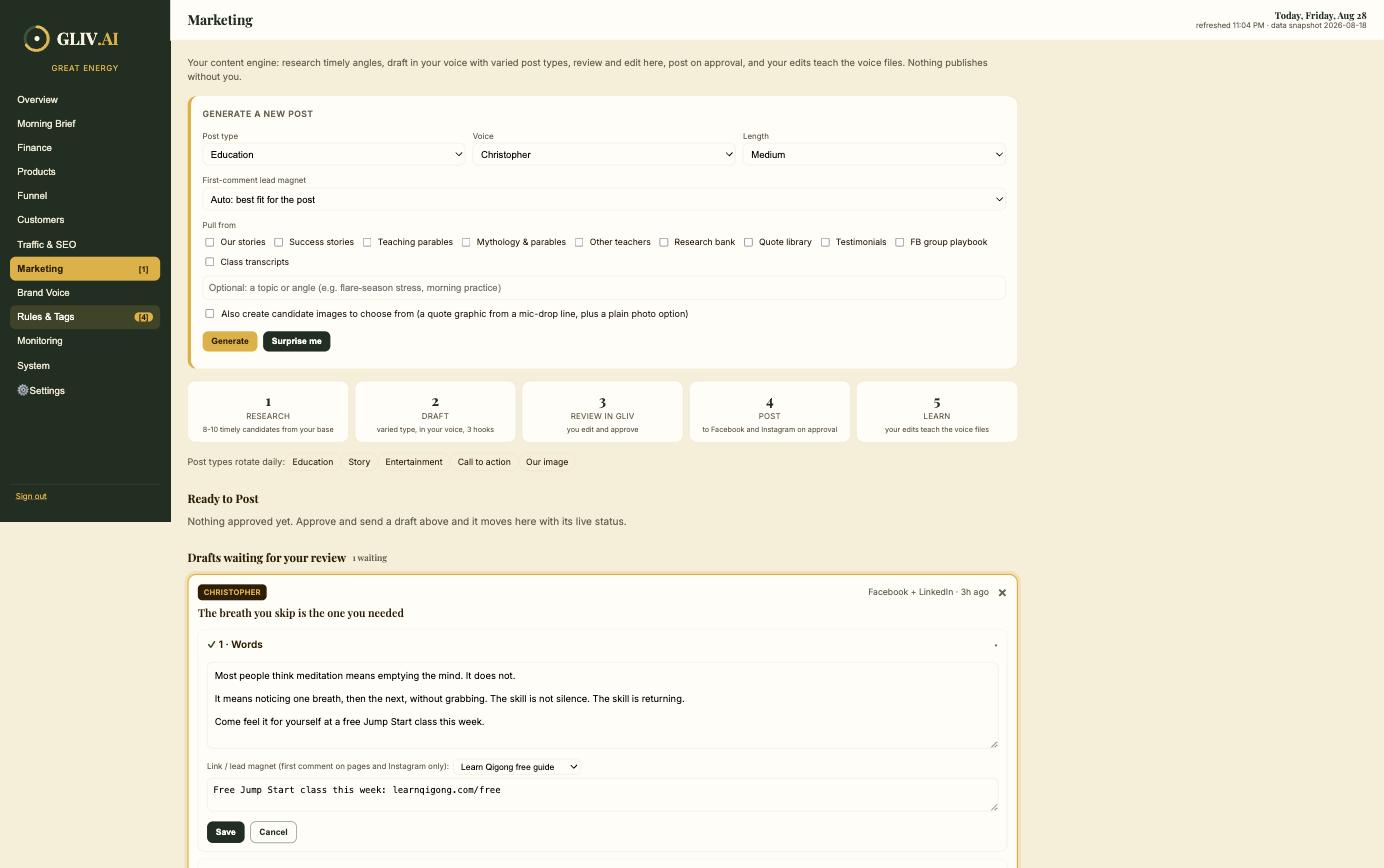
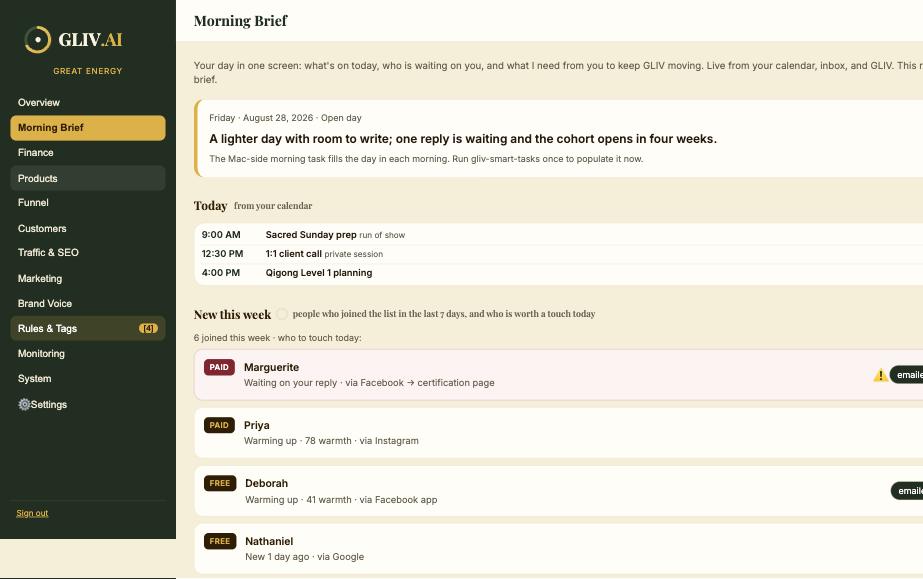
GLIV.AI is the AI operations platform we built for our own business, and it is the clearest answer to 'does this actually work.' It runs the repeated work of a real company every day: content drafting, scheduling and posting, monitoring, follow-up, and the morning reporting that used to eat hours. We built it the way we build for clients, one automation at a time, each one proven before the next, with a person kept on the decisions that matter.
Because we run it ourselves, we feel every rough edge before a client would. That is the point of building our own house first: what we bring you has already survived contact with a real operation.
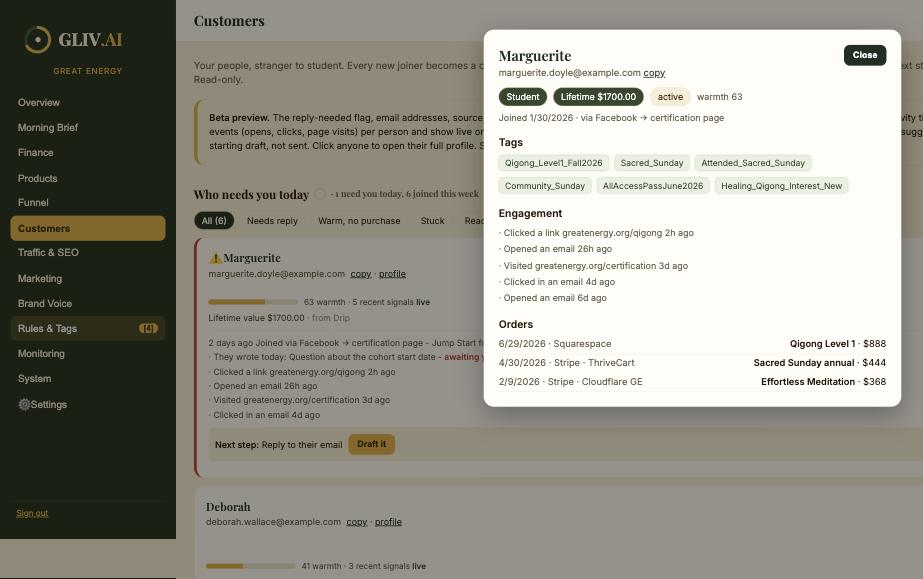
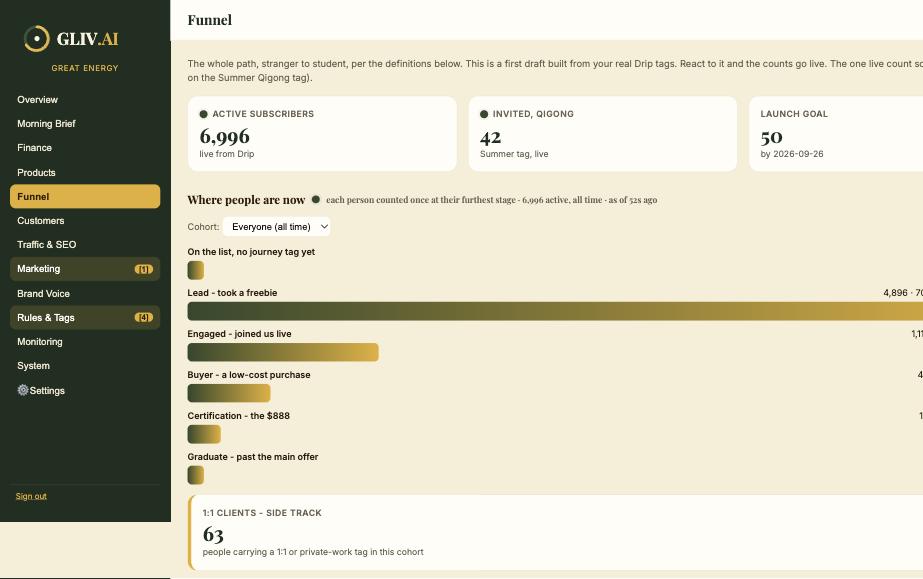
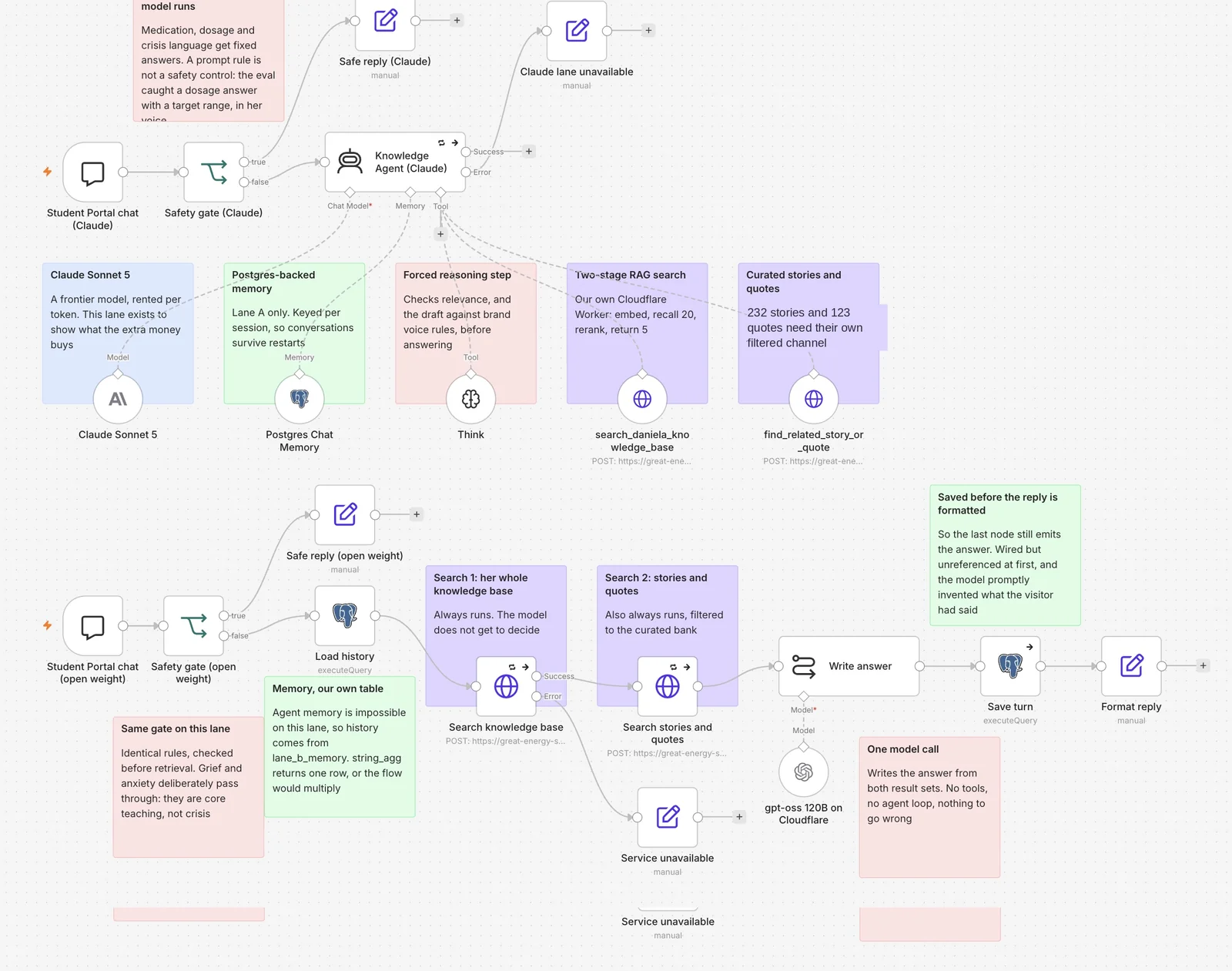
For Great Energy, one of our own companies, we built 'Ask Daniela,' a private assistant that answers only from one teacher's own decade of transcripts, articles, and notes, with a second teacher's material already ingested and held in a separate knowledge base. Great Energy is a part-time education business Christopher built with his wife Daniela, so this ran in our own shop first. Every answer is grounded in that teacher's real work, and a curated story or quote is pulled alongside it. The embeddings and reranking run on Cloudflare, and Claude writes the final answer. It is live now on the Great Energy site, and it is the pattern for any business sitting on years of material nobody can search.
We run it two ways over the same knowledge base: a Claude Sonnet 5 agent, and an open-weights pipeline on Cloudflare, so a business can see whether it needs to pay frontier-model prices. Medication and crisis questions route to fixed responses before any model runs, and when we audited our own index and found private material was retrievable, we contained it the same day and added tests so it cannot return.
The Autoimmune Recovery Method is another of our own companies. We built a large, sourced education library and put AI to work on the research and the first draft, with a certified subject-matter expert, Daniela Hess, a certified AIP coach, verifying and shaping every piece before it published. The result is a structured, fully searchable resource, grounded in cited research rather than generated from nothing. It is the pattern for any business sitting on deep expertise that needs to become a searchable, trustworthy library at a scale no one could write by hand.
The build principle is the same one behind everything else here: AI does the heavy first pass, a qualified person stays on the judgment, and nothing ships unverified.
This is the one we are building now, aimed squarely at the billing and revenue world. It is two agents on a single pricing engine. The first, a Pricing Builder, turns a pricing idea written in a sentence into a structured model and a correct sample invoice. The second, a Revenue-Leakage Auditor, takes a set of billing records and the same pricing rule, recomputes what each account should have been charged, and flags the money slipping through. They share one engine on purpose, the same parser and the same math powering both, which is what makes this a platform rather than two clever scripts. And one rule runs through all of it: AI reads the language, code computes every dollar, and a person decides what to do about it.
| First 1,000,000 @ $0.002 | $2,000.00 |
| 500,000 above 1M @ $0.002 | $1,000.00 |
| Volume discount, 10% | -$100.00 |
| Total | $2,900.00 |
| Account | Charged | Expected | Delta |
|---|---|---|---|
| Bolt | $1,200 | $1,600 | -$400 |
| Cair | $3,500 | $3,800 | -$300 |
| Dyno | $0 | $600 | -$600 |
| Echo | $2,300 | $2,360 | -$60 |
| Gale | $2,000 | $1,800 | +$200 |
These are built as deployed agents, an n8n workflow behind a rate-limited API, with every number computed in code so it is auditable, and a hardened, tested architecture underneath. Both are live and running now. Type your own pricing model into the first and see what it returns, then give the second a rule and a set of billing rows and watch it reprice every one and flag the gaps. They share a single pricing engine, so the two can never disagree about what a rule means.
For the Ithaca City School District, we built a custom asset system that returned its cost in under 3 months and is still a core system 20 years later, tracking 64,189 assets. That longevity is the track record every AI build inherits: scope it tight and build it to last, so the value proves itself early. And it did not stand still. We used AI to build a reporting layer on top of it, so those 64,189 assets can be broken down and viewed many different ways, cut by building or category or age or whatever question comes up that day. A clever demo is easy. A system that still runs 20 years on, and keeps getting more useful, is the harder and more valuable thing.
| Tag | Asset | Building | Status |
|---|---|---|---|
| A-10442 | Chromebook, student | High School | In service |
| A-02218 | Projector | Middle School | In service |
| A-31905 | HVAC unit | Facilities | Maintenance |
| A-00761 | School bus | Transportation | In service |
| A-18830 | Upright piano | Elementary | In service |
| A-27414 | Laptop cart | High School | Retired |
This year Christopher trained 71 non-technical business owners to use AI on real work, in their own ChatGPT or Claude, taking them from a first prompt to a result they could run themselves. In a single working session, owners who had never built an automation produced a fully researched outreach list for their own event. The measure of the teaching is what they walk out able to do on their own.
| Name | Focus | Best-fit topic | Personalized hook | |
|---|---|---|---|---|
| Alex Rivera | Course creators | Launch funnels | Referenced their recent live launch | View |
| Sam Ortega | Wellness studios | Membership growth | Noted their new class format | View |
| Priya Nair | Coaches | Group programs | Cited their podcast episode on pricing | View |
| Jordan Lee | Local services | Referral systems | Mentioned their community sponsorship | View |
The same building blocks sit behind every service. Here they are twice: once for the owner, once for whoever on your team wants the detail.
In short: a repeated job gets turned into steps the system runs on its own, and checks with a person where it matters.
Technical: workflows built in n8n, each step scoped to a defined tool set and permissions, triggered by events or schedules, with human-in-the-loop checkpoints on anything that sends, pays, or publishes.
In short: the AI can reach the systems you already run, without a tangle of brittle integrations.
Technical: we connect data and tools with MCP, a common language between AI systems, which removes most of the one-off Zapier and API glue that used to make integrations fragile.
In short: it answers from your real documents, and it remembers what it should between sessions.
Technical: retrieval over your own documents grounds answers so they are accurate, not just fluent, and a memory file each session writes to gives persistence a stateless model does not have on its own.
In short: a person stays on the decisions that matter, and the system only touches what you allow.
Technical: least-privilege permissions per step, data-handling rules by tool tier, and a human-in-the-loop gate on outbound actions, so AI proposes and a person decides.
The same team, the same discipline, across 20 years of builds. A few of the people we have built for.
We needed a logo and website, and a complex back-end: an e-commerce app with registration, payments, and a database with complex rules and entity routing. GORGES handled it all with professionalism and brought our ideas to life.
GORGES built a Learning Management System integrated with our SUNY Cortland payment system, and a powerful recreation database with a user-friendly back-end and an attractive public front-end. We are now working on an app for the next phase.
GORGES has built and managed our complex set of web-based tools since 2009, through multiple generations. The original system went live in 2010 and is still in service today, with very few support calls. The team can do pretty much anything you want.
Start with a free 20-minute call. We will show you a demonstration live and talk through where it fits. From there, the AI Readiness Diagnostic is $250 with a written report and a plan, credited to your first month of any service.